Eco Friendly Travel: A Guide to Sustainable Journeys

True eco friendly travel isn't about giving up comfort or adventure; it's about making smarter, more intentional choices that actually make your journeys richer. Think of it as upgrading your travel mindset from simply visiting a place to truly connecting with it. This guide will show you how to make that happen.
This small shift in perspective changes everything. It means prioritizing experiences that support local communities and protect the natural environments you came to see. It’s about being a conscious traveler.
Forget the vague buzzwords. Genuine eco-friendly travel offers a clear framework for exploring the world. It’s a conscious effort to minimize your negative impact while maximizing your positive contributions, from the moment you start planning to your daily habits on the ground.
Affiliate disclosure: This post may contain affiliate links. If you buy through them, Eco Nomad Travel may earn a small commission at no extra cost to you.
What Eco-Friendly Travel Really Means
At its heart, this travel style is built on a few simple, powerful ideas. It champions transport with a lower carbon footprint, supports accommodations genuinely committed to conservation, and encourages habits that reduce waste and benefit local economies. Consequently, it’s a holistic view that weaves environmental stewardship and cultural respect together.
People often use “eco-friendly” and “sustainable” travel interchangeably. While they're close cousins, they have distinct focuses. Eco-friendly practices specifically target reducing environmental harm—like choosing a train over a plane. For a deeper dive into the broader social and economic picture, you can learn more about what sustainable travel is in our detailed guide.
Shifting From Consumer to Contributor
The biggest change is mental. Instead of seeing a destination as a product to be consumed, you start to see it as a living ecosystem you’re temporarily part of. As a result, this perspective naturally leads to more mindful decisions.
It's the difference between booking a large international hotel chain and choosing a locally-owned guesthouse that uses solar power. It might mean spending an afternoon helping a local conservation project instead of taking a resource-heavy tour. These aren't sacrifices; they're choices that transform a simple vacation into a regenerative experience for you and the place you're visiting.

The Three Pillars of Conscious Journeys
To make this practical, you can break eco-friendly travel down into three main areas. Each one is an opportunity to make a real difference without compromising the quality of your trip.
- Low-Impact Transport: This is your biggest lever for change. Prioritizing rail travel, using public transit, and exploring cities on foot or by bike drastically cuts your carbon footprint.
- Regenerative Stays: This means seeking out accommodations that actively work to improve their local environment—think robust recycling programs, water conservation systems, and strong community partnerships.
- Mindful Consumption: This covers everything from your packing list to where you eat. It means carrying reusables to avoid single-use plastics, eating at restaurants that source local ingredients, and buying souvenirs directly from the artisans who made them.
Why Your Eco Friendly Travel Choices Matter Now More Than Ever
The idea of sustainable travel has moved firmly from the fringe to the mainstream. It’s no longer a niche interest for a handful of dedicated travelers; it’s becoming a powerful global priority. More and more, people are looking for journeys that do more than just get them to a destination—they want trips that reflect their values and create a positive ripple effect through the entire tourism industry.
This isn’t just a passing trend. It's a fundamental shift in how we see the world and our role in it. Every choice you make, from the train ticket you book to the local cafe you support, is part of this larger, positive change. Opting for eco friendly travel is a chance to actively help preserve the places we love for generations to come.
This whole movement is fueled by real economic and cultural momentum. Airlines, hotels, and tour operators are responding to clear consumer demand for greener, more thoughtful practices. Understanding this shift shows that sustainable journeys aren't just better for the planet; they're becoming the new standard for meaningful exploration.
The Economic Power of Conscious Choices
The numbers tell a powerful story. The global sustainable tourism market is one of the biggest economic shifts of the 2020s, with projections showing explosive growth. The market is expected to hit $11.53 trillion USD by 2033. That isn't just an industry metric; it's a direct reflection of your choices.
As of 2025, an overwhelming 90% of consumers are actively looking for sustainable travel options. Even better, they're willing to pay an average of 38% more to ensure their experiences don't harm the planet. This commitment is especially strong among younger travelers, with Gen Z showing a clear preference for destinations that encourage sustainable tourism. These trends are sending an unmistakable message that responsible business is good business. You can discover more insights about these global tourism trends and see how consumer demand is shaping the future of travel.
Reshaping the Travel Industry from the Ground Up
This consumer-led movement is forcing the industry to adapt, and we're seeing real changes on the ground as a result:
- Transportation providers are investing in more fuel-efficient fleets and promoting lower-carbon options like rail.
- Accommodations are rolling out verifiable waste reduction programs, switching to renewable energy, and sourcing food locally.
- Tour operators are creating experiences focused on authentic cultural exchange and direct support for local communities.
This evolution means that planning an eco friendly travel itinerary is easier than ever before. For a complete overview of strategies and tips, check out our comprehensive green travel guide for 2025, which details how to make the most of these positive industry shifts. Your demand for better options is accelerating the transition to a more responsible and regenerative model of tourism worldwide. Ultimately, your wallet is your vote for a healthier planet.
Planning Your Eco Friendly Travel with a Rail-First Approach
Your biggest chance to make an eco friendly travel trip happens long before you even think about packing. It starts with one simple but powerful decision: how you're going to get there. Putting trains first—what I call a rail-first approach—is the cornerstone of low-impact travel, slashing your carbon footprint right from the get-go.
Think of your travel choices like an investment in the planet. Choosing the train over a short-haul flight is one of the highest-return investments you can make. While no transport is completely carbon-free, the difference between rail and air is staggering. Therefore, it's easily the most significant decision you'll make.
This shift in mindset isn't about limiting yourself. It's about unlocking a different, and often richer, way of seeing the world. It’s about slowing down, watching landscapes unfold from your window, and arriving right in the heart of a city, ready to explore.
Understanding the Emissions Gap: Rail vs. Air
To really get why trains are a game-changer, it helps to see the numbers side-by-side. Flying, especially on short-haul routes, is one of the most carbon-intensive things any of us can do. In stark contrast, modern electric trains—particularly those powered by renewable energy—offer a remarkably clean ride.
This isn't a small difference. A journey by train can emit up to 90% less carbon than the same trip by plane. This massive gap is why putting rail first is so effective for anyone serious about traveling more sustainably.
It's not just about individual choices, either. Recent data shows the wider tourism industry is making progress. Global greenhouse gas emissions in travel fell by 9.3% since 2019, even as the sector grew. The key metric, emissions intensity, dropped by 15% in the same period. For us travelers, this highlights a crucial point: your choice of transport directly shapes your personal carbon footprint because a train's emissions intensity is a fraction of a plane's. You can read the full research on travel emissions intensity to dig into the data.
Travel Emissions: A Quick Comparison Per Passenger Mile
This table breaks down the typical carbon dioxide (CO2) emissions for common modes of travel, showing why choosing the train over a plane makes such a significant difference for eco friendly travel. All weights are in US standard measurements.
Mode of TransportAverage CO2 Emissions (pounds per passenger mile)Domestic Flight0.55 lbsCar (driver only)0.95 lbsIntercity Bus/Coach0.20 lbsIntercity Rail/Train0.15 lbs
As you can see, the numbers speak for themselves. The gap between flying and taking the train is huge, making rail the clear winner for lower-impact journeys.
Designing Your Rail-First Itinerary
Planning an eco friendly travel itinerary around trains is much easier than you might think, especially in places with great networks like Europe and parts of Asia. The real trick is to start seeing the journey itself as part of the adventure.
A great way to start is by picking a "base city"—a well-connected hub with excellent rail links. Cities like Berlin, Vienna, or Bangkok are perfect springboards for exploring entire regions without ever setting foot on a plane. From your base, you can take easy day trips or short overnight journeys to nearby towns and natural wonders. For more inspiration, check out our guide to flight-free travel itineraries.
Platforms like Trip.com are brilliant for this, as they let you compare and book train routes across multiple countries, taking much of the headache out of the planning. If you need flights, Aviasales can help you find the most direct routes.
The Strategic Value of Night Trains
Night trains are a sustainable traveler's secret weapon. Seriously. They bundle your transport and accommodation into one, saving you both time and money. You board a train in one city, get a decent night's sleep in a couchette or sleeper car, and wake up refreshed and ready to go in a completely new destination.
This strategy is a triple win:
- Saves Money: You skip the cost of a hotel room for one night.
- Maximizes Time: You travel while you sleep, which frees up all your daylight hours for exploring.
- Reduces Stress: You get to bypass the entire airport ordeal—no security lines, no chaotic boarding gates, no painfully early alarms.
Just remember to book these routes in advance, as the popular ones can sell out quickly. Using a reliable booking platform like Trip.com ensures you can lock in your spot and plan your trip with confidence. This simple approach turns a basic A-to-B journey into an efficient and memorable part of your eco friendly travel experience.
Finding Regenerative Stays Instead of Greenwashed Hotels
How you travel is one half of the equation; where you stay is the other. To make your trip genuinely eco friendly, the goal is to find accommodations that are regenerative—places that actively heal and improve their local environment and community, rather than just ticking a few green boxes.
This is a huge step up from hotels that simply ask you to reuse your towels. A truly regenerative stay operates on a philosophy of giving back more than it takes. Think of it as investing your travel dollars directly into the health of the destination, ensuring your visit leaves the place a little better than you found it.
The tricky part? Spotting the difference between real commitment and slick marketing, a practice known as "greenwashing." Lots of hotels toss around vague terms like "eco-conscious" without offering any proof. Learning to look for verifiable actions is how you make a choice that actually backs up your values.
What to Look For in a Genuinely Sustainable Stay
To cut through the marketing fluff, you need a clear mental checklist. Authentic regenerative properties aren't shy about their practices—they show them off with transparent, measurable actions. Before you even think about booking, scan their website for solid evidence of these core pillars.
Here’s what a truly sustainable accommodation looks like in practice:
- Verifiable Waste Reduction: They have concrete programs in place. Look for mentions of composting systems, a total ban on single-use plastics, and comprehensive recycling. Do they actually measure and report their waste output?
- Renewable Energy Sources: The best eco-lodges are investing in their own energy, often with solar panels or geothermal heating. You should be able to find details about where their power comes from.
- Smart Water Conservation: Water is precious, and regenerative stays treat it that way. This can mean rainwater harvesting systems, greywater recycling for gardens, and installing low-flow fixtures throughout the property.
- Genuine Community Partnerships: This is non-negotiable. Does the property hire and train people from the local community? Do they source their food from nearby farms or feature work from local artisans? This ensures your stay directly benefits the local economy.
The good news is that traveler demand is forcing the industry to change. By 2025, a massive 93% of global travelers said they want to make more sustainable choices, and 69% specifically want to leave the places they visit better than they found them. This groundswell is making it much easier to find places that meet these higher standards. You can read the full research on traveler awareness to see just how much our collective mindset is shifting.
Navigating Certifications and Booking Platforms
Certifications can be a useful shortcut, but they aren't all created equal. You'll want to look for labels recognized by the Global Sustainable Tourism Council (GSTC), as these require tough, third-party audits. Certifications like Green Key, EarthCheck, and B Corp are all strong signals that a property's commitment is the real deal. For a complete rundown, check out our detailed guide on how to avoid greenwashing and find truly sustainable stays.
Booking platforms are also starting to catch on. On sites like Trip.com, you can now use filters to find properties that hold recognized eco-certifications. This little feature saves a ton of time and gives you confidence that you’re supporting a business that’s been properly vetted, making it simple to weave eco friendly travel principles right into your planning.
The infographic below really drives home why these choices matter, showing the huge difference in emissions between train and air travel. It’s a stark reminder of how our transport decisions form the foundation of our travel footprint.
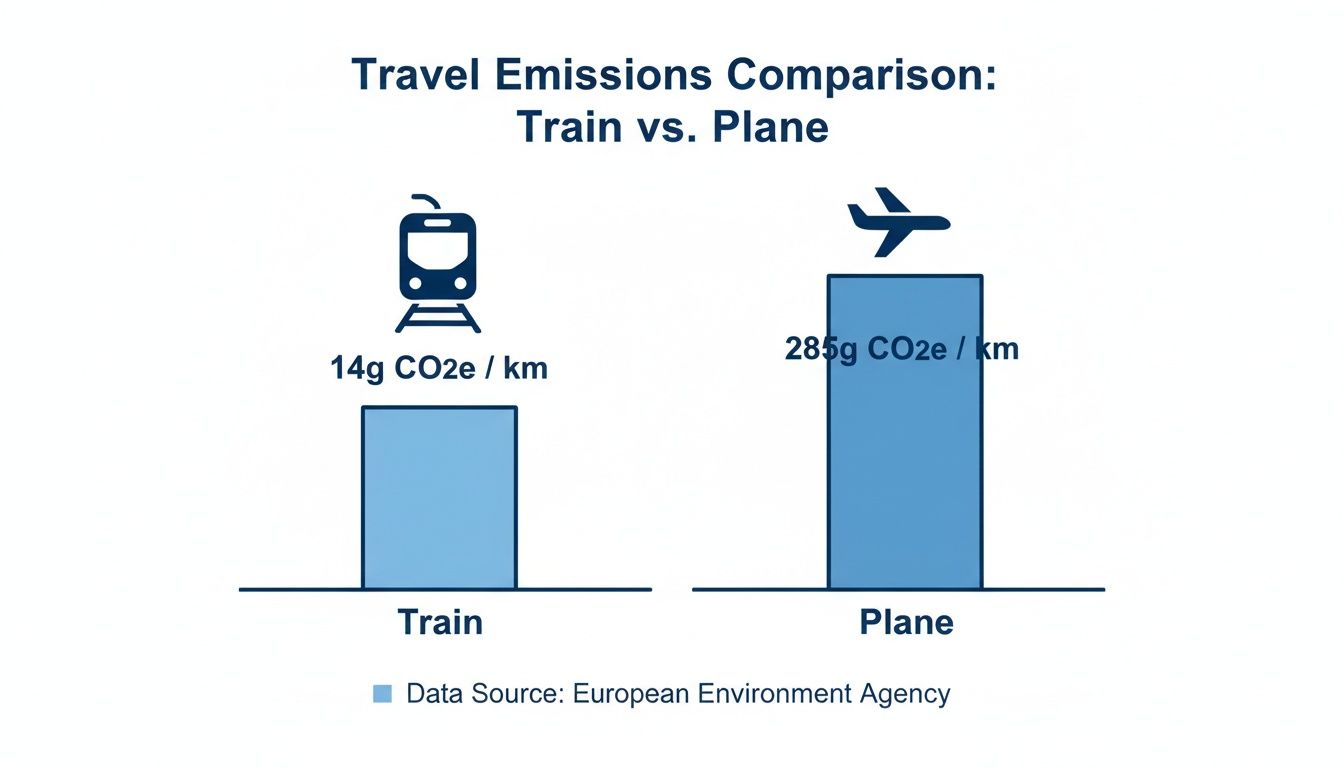
As the data clearly shows, flying pumps out dramatically more carbon per kilometer than traveling by train. This makes rail the undisputed champion for any low-impact journey.
Building Your Zero-Waste Packing System
Thinking about eco friendly travel goes all the way into your backpack. A zero-waste packing system isn't just a random pile of gear; it’s a thought-out, self-sufficient kit designed to cut out single-use plastics and shrink your footprint on the road. It’s a hands-on way to travel lighter, smarter, and with a whole lot more intention.
Think of your bag as a mobile toolkit for living sustainably. Every single item has a purpose and earns its spot by being durable and reusable. Shifting your mindset from disposable to durable is the absolute foundation for stopping that trail of waste that typical travel leaves behind.
It all starts by saying no to the throwaway culture of tiny, travel-sized toiletries and endless plastic water bottles. Instead, you build a reliable kit that goes with you on every trip, saving you money and stopping countless bits of plastic from choking landfills or oceans.

Core Components of a Low-Impact Kit
Putting your system together is pretty straightforward once you know the key swaps. These reusable alternatives are the bedrock of any real zero-waste packing strategy. They’re simple, they’re practical, and they make a huge difference over time.
- Filtered Water Bottle: This is your number one. A solid bottle with a built-in filter, like a GRAYL GeoPress Water Purifier, means you can safely refill from taps pretty much anywhere in the world. It completely wipes out the need to buy bottled water, saving you hundreds of dollars and preventing hundreds of plastic bottles from ever being used.
- Solid Toiletries: Liquids are a pain—they’re heavy, messy, and always come in plastic. Switching to solid shampoo bars, conditioner bars, and toothpaste tabs is a total game-changer. They last way longer, are incredibly light (most are just a few ounces), and are completely plastic-free.
- Compact Food Containers: A collapsible silicone container or a set of reusable beeswax wraps lets you pack snacks, save leftovers from a great meal, and dodge single-use takeaway containers. They're perfect for picking up things at a local market or grabbing a bite for a long train ride.
For a full, detailed checklist, check out our dedicated zero-waste packing list for 2025.
https://economadtravel.com/eco-friendly-travel/
Comments
Post a Comment